








Damages · civil litigation attorneys
Civil litigation,
answered with results
Damages, loan recovery and contract disputes: a dedicated civil litigation attorney takes the case in person from the first day.
PROFESSIONALS
Civil litigation attorneys
A task force of one to twenty attorneys, including civil litigation specialists, works as one team on your case
VIEW MORE
Damages and loan recovery litigation Contract disputes and many other civil matters
Han Byung-chulCivil litigation attorney

Damages, loan recovery and other civil matters Provisional attachment and enforcement proceedings
Lee Un-yeongCivil litigation attorney

Damages, loan recovery and other civil matters Provisional attachment and enforcement proceedings
Lee Dong-gyuCivil litigation attorney

Damages, loan recovery and other civil matters Provisional attachment and enforcement proceedings
Lee Gyu-huiCivil litigation attorney

Damages, loan recovery and other civil matters Provisional attachment and enforcement proceedings
Yu Ji-hyeonCivil litigation attorney

Damages, loan recovery and other civil matters Provisional attachment and enforcement proceedings
Oh Dong-junCivil litigation attorney

Damages, loan recovery and other civil matters Provisional attachment and enforcement proceedings
Shin Ye-wonCivil litigation attorney

Damages, loan recovery and other civil matters Provisional attachment and enforcement proceedings
Park Su-gyeongCivil litigation attorney

Damages, loan recovery and other civil matters Provisional attachment and enforcement proceedings
Park Min-jeongCivil litigation attorney

Damages, loan recovery and other civil matters Provisional attachment and enforcement proceedings
Noh Hwan-juCivil litigation attorney
How a case proceeds
Six steps from consultation to enforcement
Daehanjoongang stays in direct contact with you at every stage and sees the case through to the end.
Request a consultation- 01
Consultation request
Call or request a consultation online, and a member of the team contacts you.
CONSULT
- 02
Case analysis
Your attorney reviews the facts, the evidence and the issues at the outset.
ANALYSIS
- 03
Engagement
The scope of representation and the fees are explained clearly before the engagement is signed.
CONTRACT
- 04
Litigation strategy
The cause of action and the plan of proof are designed on case law and the evidence.
STRATEGY
- 05
Litigation
Drafting the complaint and briefs, appearing at hearings, examining witnesses and mediation.
LITIGATION
- 06
Judgment and enforcement
After judgment, advice on appeal and the follow-through to enforcement.
EXECUTION
Legal information
Civil law information from our attorneys
Case law developments and litigation practice in damages, debt recovery and contract disputes, written by our civil litigation attorneys.
10/14/2026
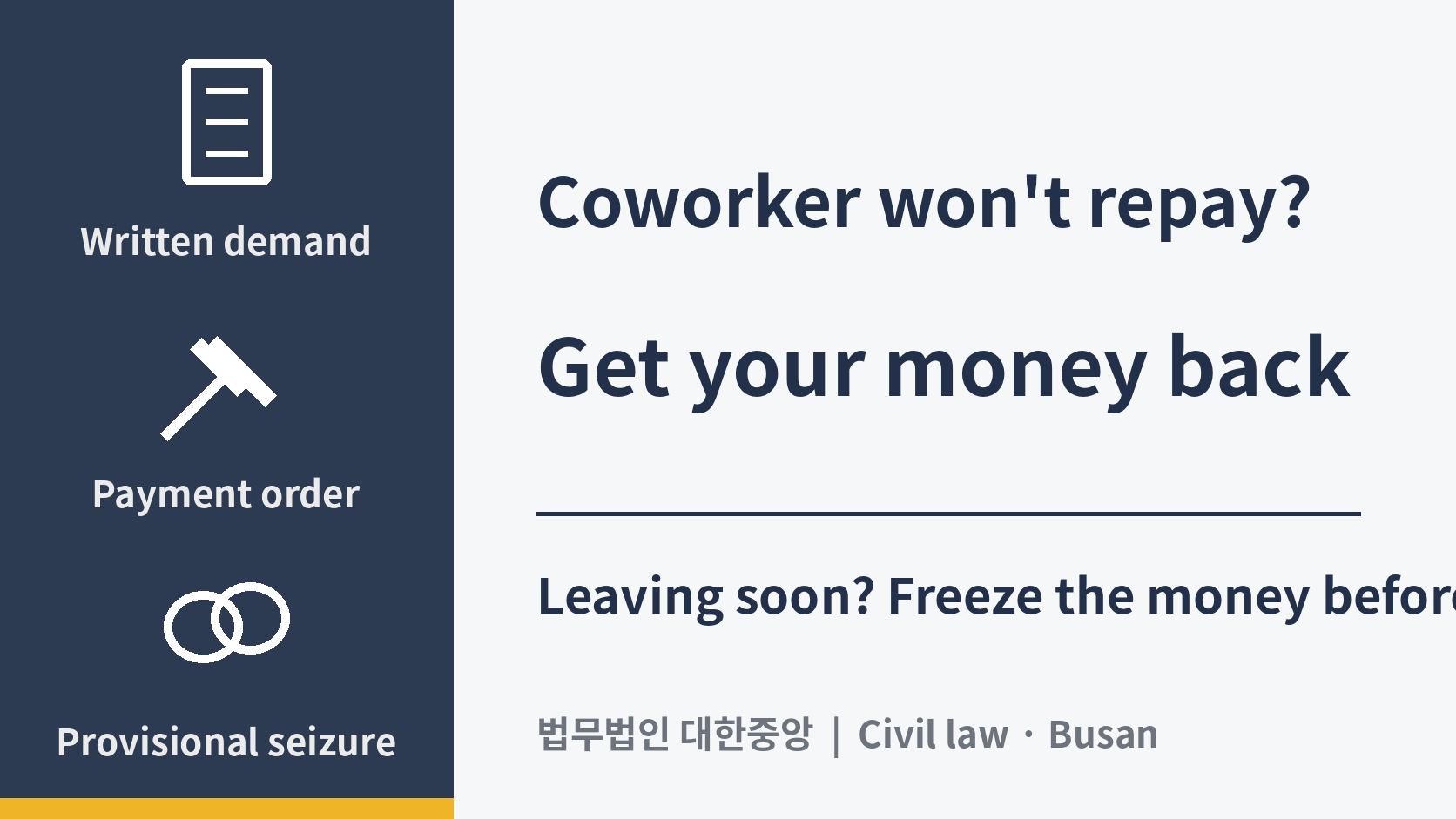
A coworker won't repay a loan. How do I get my money back in Korea?
You can claim it even without a signed paper. Under Korean law a loan exists once one person agrees to hand over money and the other agrees to return the same a…
Read the articleLEGAL VIDEO GUIDE
Civil litigation and enforcement, explained on video
Practical legal explanations from Daehanjoongang's civil litigation attorneys
Daehanjoongang Law FirmVisit the channel
민사항소, 무작정하면 안 됩니다 | 부산 변호사 한병철 변호사
Hanbyun TV|Daehanjoongang Law Firm official channel
Our attorneys' activity, in numbers

Han Byung-chul, answering the public
A record of the legal questions our managing attorney has answered on the largest public Q and A service in Korea.
Updated automatically from public activity records
Every practice areaat a glance
- Traffic accident damages
- Medical malpractice damages
- Industrial accident damages
- Defamation and insult damages
- Insurance claim disputes
- Loan recovery claims
- Claims for goods and services
- Unjust enrichment claims
- Payment orders and small claims
- Limitation period management
- Breach of contract
- Rescission and termination
- Penalty and liquidated damages clauses
- Return of deposits and instalments
- Contract review and dispute prevention
FAQ
Civil litigation: common questions
The questions our civil litigation attorneys in Haeundae, Busan are asked most often at a consultation.
A general civil claim is subject to a ten-year limitation period, and a claim arising from a commercial transaction to five years. A claim for damages in tort expires three years after the day you learned of the loss and of the person responsible, and in any event ten years after the wrongful act. Some claims, such as construction payments or the price of goods, carry a short period of three years or one year, so each case has to be checked on its own facts. The period is interrupted by filing suit, applying for a payment order, obtaining a provisional attachment or injunction, or by the debtor acknowledging the debt, so if the deadline is close the first step is to consider how to interrupt it.
It varies with the difficulty of the case and the court’s schedule, so no single figure is meaningful. A small claim or a straightforward loan case may reach a first-instance judgment within a few months, while a damages or construction payment case that needs a medical, valuation or document expert examination often runs beyond a year at first instance alone. An appeal, and then a further appeal, extend it. Conversely a mediated or settled outcome can shorten it considerably, so it is worth weighing litigation against mediation at the start.
The Civil Procedure Act places the costs of the proceedings on the losing party, and attorney fees are included in those costs. They are recognised only within the limits set by the rules on including attorney fees in litigation costs, which are tied to the value of the claim, so the full amount actually spent is rarely recovered. Where you succeed only in part, the court apportions the costs according to the outcome. Court stamp duty and service fees are paid by the plaintiff at the outset and settled after the judgment becomes final, through an application to fix the amount of costs.
If the other side disposes of assets or transfers them into another name while the case is running, you can win and still recover nothing. A provisional attachment secures real estate, deposits, wages or receivables in advance to prevent that, and it can be applied for before the suit is filed. The court decides on a showing of the claim to be secured and of the need for security, and usually requires security in the form of a cash deposit or a guarantee insurance policy. If an attachment is pushed through on a claim that is not made out, you may have to compensate the loss it caused, so the basis of the claim and the target assets should be reviewed together before applying.
A payment order is a summary procedure decided on the documents without a hearing; the stamp duty is a tenth of that for an action and the decision comes relatively quickly. If the debtor files an objection within two weeks of being served, however, the case simply moves into ordinary proceedings. A payment order also cannot be used where the debtor’s address is unknown and service by publication is required. Where the other side is likely to contest the claim, filing an action from the start often saves time. A final payment order is a basis for enforcement but has no res judicata effect, so the debtor can still raise an objection to the claim.
In civil proceedings the party asserting a fact in its favour bears the burden of proving it. Even without a contract, bank transfer records, text and messenger conversations, quotations, tax invoices, emails and a recording of a call you were party to can together form a coherent account that the court accepts. Material held by the other side or by a third party can be obtained through an order to produce documents, a request to send documents, a request for factual enquiry, or an order to produce financial transaction information. If material may be lost or damaged, evidence can be preserved even before the suit is filed, so it is worth checking what can still be obtained before concluding that the evidence is insufficient.
A judgment does not bring in the money by itself; a separate enforcement procedure is needed. Once an enforcement clause is endorsed on the authenticated judgment and a certificate of service is obtained, you can apply for a compulsory auction of real estate, an attachment and collection order over deposits, wages or receivables, or an attachment of movables. If you do not know what the other side owns, a declaration of assets and an asset enquiry can establish it, and a debtor who does not comply without good reason may be entered in the register of defaulters. A claim confirmed by a final judgment is enforceable for ten years, and a fresh action before that period runs out extends it. In practice, whether a provisional attachment was obtained early often decides whether anything is recovered.
A mediation record and a settlement record have the same effect as a final judgment, so if the other side does not keep to it you can enforce directly. A judgment either grants or dismisses the claim, with nothing in between, whereas mediation allows terms a judgment cannot carry: when payment is made, whether it is made in instalments, and how mutually entangled claims are resolved. It also removes the risk of an appeal, ending the dispute at that stage and bringing recovery forward. Once concluded it is in principle difficult to reopen, so the concessions should be weighed against the prospects of success and of actually enforcing the judgment.